
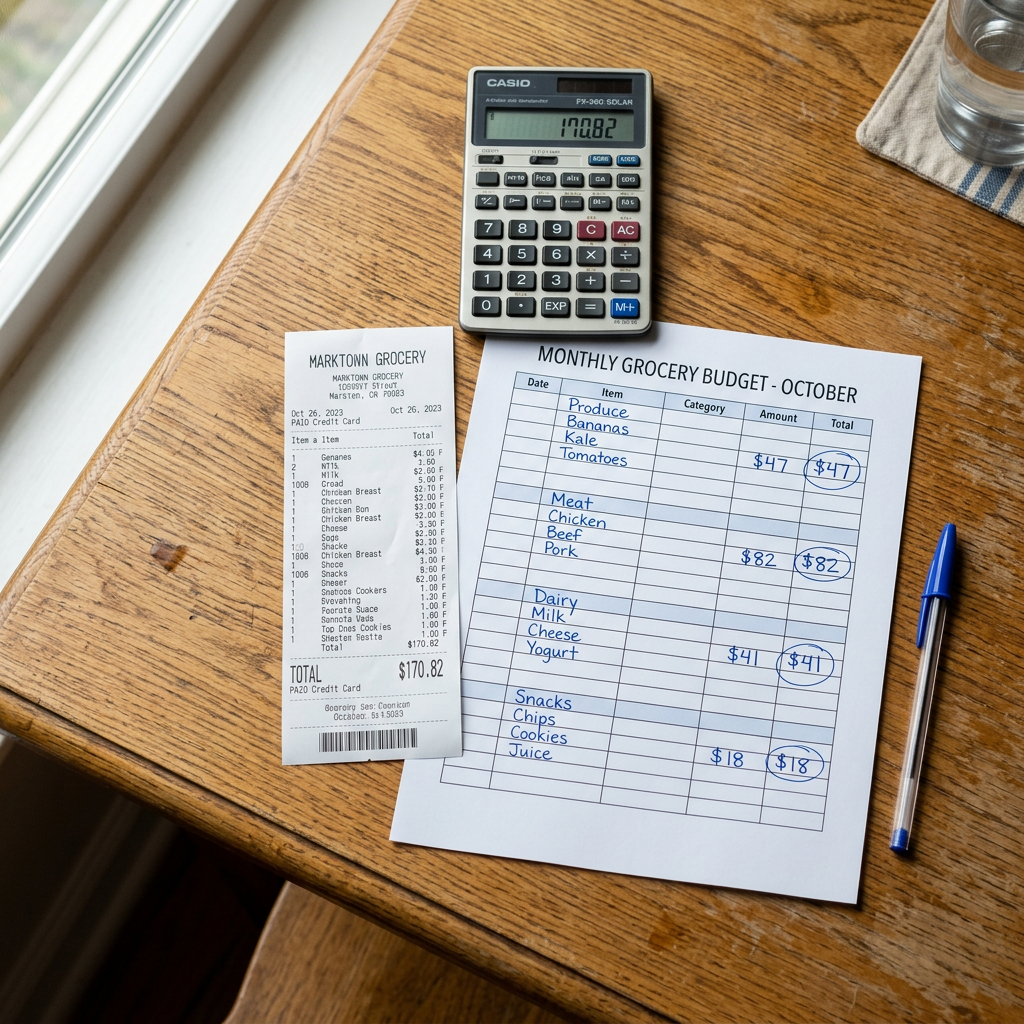

Family of Three Spent $169.51 on Dinner. Not a Week. Just Dinner.
A family of three posted they spent $169.51 on dinner. Not a week. Not two weeks. Just dinner for tonight and a little leftover for lunch tomorrow.
They posted a photo of that thin receipt paper in the parking lot. Chicken thighs, a bag of rice, two bags of mixed vegetables, a gallon of milk, a loaf of bread, a bottle of cooking oil because they ran out yesterday, and a small juice for their kid. That’s it. No steak. No fancy cheese. Nothing from the bakery. Their cart didn’t even look full.
With Thanksgiving and Christmas coming in the next 6 weeks, a lot of families are starting to panic. USDA says the cost of a Thanksgiving dinner for 6 people is up again this year. I’m already seeing families on Facebook posting their holiday grocery carts at $200+ just for one meal. If one regular Tuesday dinner is $169 for a family of three, what is Thanksgiving going to cost? That Christmas gift fund families are trying to save is going to be gone if they don’t fix this now.
And I see it everywhere right now in the comments, in grocery groups, at the store – families posting their $1200 a month grocery bills. They are not wasting money. They are eating tuna casserole and ramen to make it stretch. They are standing at checkout putting stuff back because the total came out $40 over what they planned.
These are smart people. They meal plan. They clip coupons. They make lists. They work hard. The problem is not that they don’t know how to shop. The problem is how stores are set up. You shop by aisle – produce aisle, meat aisle, dairy aisle – but you only see one big total at the end. You never see where you actually went over.
I see this same pattern every month in the budgets families share with me. A realistic budget many families of three use is $340 for 14 days. That is what works for rent, bills, and a savings goal of that first $1,000 emergency fund.
One family I follow tracked it last month and spent $433 in those same 14 days. They went $93 over. That $93 was not from eating out. It was not from DoorDash. It was all from the grocery store because they did not check categories before they shopped. They just threw things in the cart and hoped the total would be okay at checkout. It wasn’t.
That $93 over is exactly why a lot of families can’t get to their first $1,000 in savings. It is not big purchases that stop them. It is $20 here in meat, $15 there in snacks, $30 in pantry stuff they already had at home but forgot about.
So I sat down and looked at two weeks of receipts families posted by category.
Why your grocery bill is $200 over – even when you try to be careful:
1. You shop by store, not by category.
When you push that cart, you think “I need produce, I need meat, I need milk.” You get to checkout and the cashier says $169 and you have no idea which category put you over. Was it meat? Was it snacks? Was it that juice? You don’t know, so you can’t fix it next time.
Write it like this instead: Produce: $47, Meat: $82, Dairy: $18, Snacks/Pantry: $22. When you see it that way, you know instantly – for most families of three, it’s meat. They buy chicken and ground beef in the same trip when the budget only had room for one.
2. No price check before you put it in the cart.
We grab the $6 juice box, the $9 pack of chicken, the $7 cooking oil without checking if our category is already over. The juice aisle is where it happens most. You don’t realize you already spent your full drink budget on milk earlier in the same trip. Check your sheet on your phone before you even grab a cart. It takes 10 seconds at the entrance.
3. No target that matches your actual family size.
A budget you saw on TikTok for a family of five will not work for a family of three. And a family of six can’t use a family of three budget. Your $340 for 14 days for three people looks completely different from someone else’s $800 for a month for five people. You need a target that matches your people, your store, your eating.
The 10-Second System I Share Before Families Shop – Step By Step:
This is not a quick fix. It’s a simple system. I call it Save / Spend / Grow – the same jars from the photo above.
I made one simple sheet. Keep it in your phone, and print one copy for the fridge. Before you walk into the store, at the entrance, open it and look at four lines:
Produce: Budget $___ – Spent this period $___ – Left $___
Meat: Budget $___ – Spent this period $___ – Left $___
Dairy: Budget $___ – Spent this period $___ – Left $___
Snacks / Pantry: Budget $___ – Spent this period $___ – Left $___
Example from a family sheet this week: Meat budget is $80 for two weeks. They had already spent $82 by day 9. So on that $169 trip, they knew they could not buy more meat. They put the extra chicken back. They bought the ground turkey that was on sale instead and used the chicken they had in the freezer. They skipped the extra snack box.
It took 10 seconds at the entrance. One family who used it went from $433 last month back to $341 for the same 14-day period this month. It is not about being perfect. It is about seeing it before checkout instead of after.
Download Free: Weekly Grocery Budget Worksheet
All my family budget sheets are free, no sign-up needed. Just click and print. Keep one on your fridge and one in your car